One Integration, a Million Activities: Why the Catalog Matters More Than Any Single Supplier
If you want to sell tours and activities inside your product, the first question is not "what should we show?" but "where does the inventory come from?" For most teams, the honest answer is a long list of suppliers, each with its own API, its own data format and its own quirks.
That list is where projects slow down.
The hidden cost of going supplier by supplier
Integrating a single activity provider is manageable. Integrating ten is a different job:
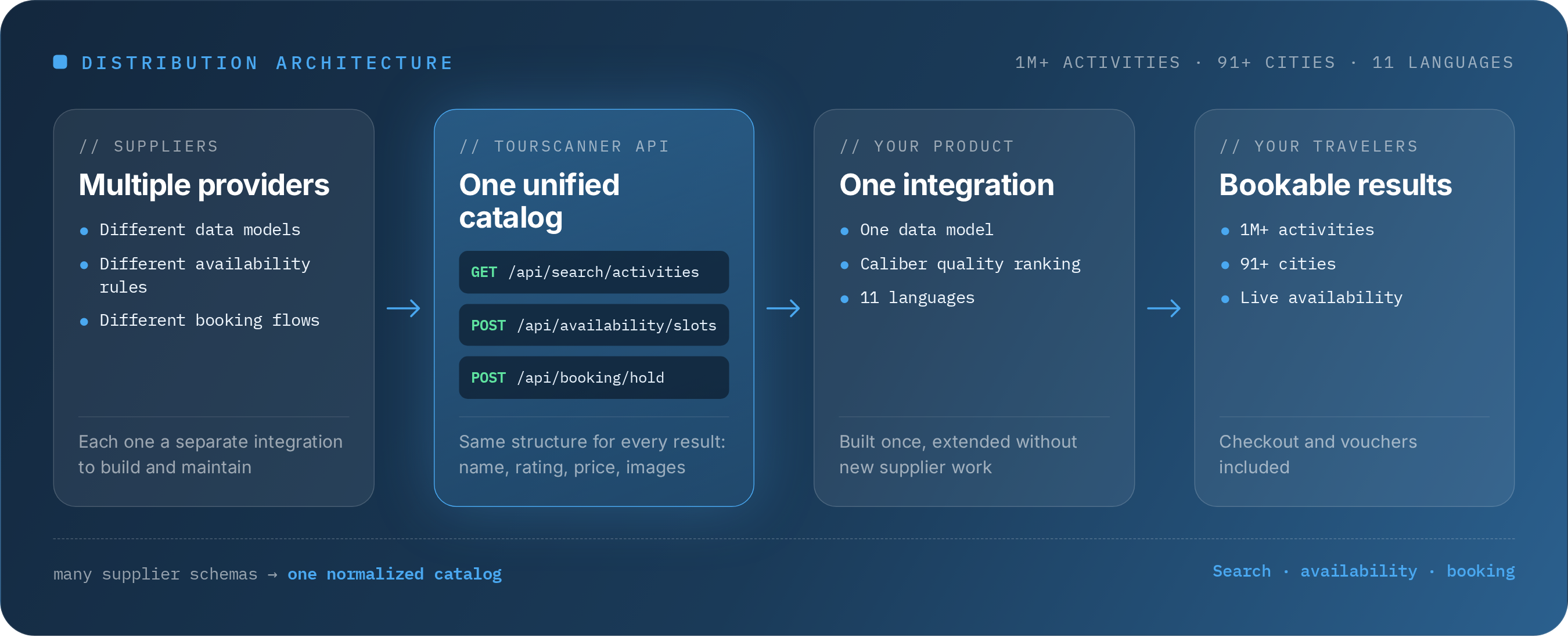
- Different data models. One supplier calls it a tour, another a ticket, another an experience. Durations, languages and pricing are described differently each time.
- Different availability logic. Time slots, capacity and cut-off times follow each supplier's own rules.
- Different booking flows. Every supplier has its own steps, errors and confirmation formats.
- Ongoing maintenance. Each integration is a commitment that needs monitoring and updates long after launch.
And even after all that work, your coverage is limited to the suppliers you managed to connect.
What a unified catalog changes
TourScanner gives you one catalog behind one API: more than 1,000,000 tours, tickets and activities from multiple providers, across thousands of cities, with content in 11 languages.
In practice, that means:
- One data model. Every result comes back in the same structure, with name, description, rating, price and a thumbnail image, so you build your interface once.
- One way to check availability. Real-time time slots and prices come from a single endpoint for activities from our connected suppliers. For the rest, the response points to the supplier's booking page where there is one.
- One booking flow. The same hold-and-confirm pipeline works for every activity from our connected suppliers (about half of the catalog), with checkout included. Other activities link to the supplier's own booking page.
- One integration to maintain. When something changes upstream, it is handled for you.
Quantity is not enough: quality ranking
A huge catalog is only useful if travelers can find the right thing in it. A search for "things to do in Rome" returns far more activities than anyone can browse.
That is why results can be sorted by Caliber, our quality-ranking algorithm, refined over 10 years of data. Instead of defaulting to the cheapest or the most heavily advertised option, Caliber surfaces the activities most likely to satisfy travelers. For a product team, that means you can show a short, strong list rather than building your own ranking logic.
Built for international products
Travel is rarely local. Your users book in one country, travel to another and speak a third language. With content available in 11 languages and coverage across thousands of cities, one integration can serve travelers across multiple markets without separate content pipelines.
What it looks like in code
A first search is a single request:
const response = await fetch(
'https://tourscanner.ai/api/search/activities?city_name=rome&sort=caliber&limit=10',
{ headers: { 'X-API-Key': 'YOUR_API_KEY' } }
)
const { activities, total } = await response.json()
From there, you check live availability and move to booking using the same API. You don't need supplier-specific code: the API tells you whether an activity can be booked directly or links to the supplier.
Who benefits
- Travel apps adding tours and activities next to flights and hotels.
- Hotels and airlines launching an ancillary revenue line without building supplier relationships.
- Content and affiliate sites turning destination pages into bookable experiences.
- AI agent builders who need a catalog their assistants can actually query and book from.
The bottom line
The value of a catalog is not just its size. It is how much work you avoid to use it. One integration instead of many, one data model instead of a dozen, and a ranking that helps travelers choose: that is the difference between a project that takes a quarter and one you can start this week.
Ready to try it? Request API access at tourscanner.ai and tell us what you're building.